Moe has had speech therapy since he was two years old. That's just over four years of speech therapy. Moe has gotten speech from early intervention, from the school district, and from a private highly recommended speech therapy practice.
We've used various methodologies from fill-ins, to singing, to PROMPT, a method designed to help people like Moe with apraxia.
Moe still doesn't talk. Not even a little bit.
I mean, he makes a lot of sounds, but very rarely are they even context-appropriate approximations. And of course, speech therapy isn't just about talking. His receptive language and communication skills (like pointing and gesturing and nodding yes and no) have greatly improved, especially in the last year.
Moe is a bright kid. He's engaged with people and his surroundings. He tries hard. But the language part of his brain is severely delayed. We know the motor planning piece is a big challenge. He will often shape his mouth correctly, but can't get the breath and sound. Or he makes the sound but can't shape his mouth. Beyond that, it is hard to say why language is so hard for him.
Moe's frustration level and associated behaviors have been increasing in speech therapy. On Monday, he tried to bite the SLP, grabbing and tearing her shirt. I felt terrible. Truthfully, I've been dreading taking Moe for a while. We spend a lot of time managing behaviors, working on the same sounds, working on a wide variety of activities but in the same office environment.
Yesterday, I received a call from the director of the clinic. She is a very intelligent, kind woman. Unlike other people we've worked with, she never implied Moe was a problem. She emphasized how much our SLP adores our family. But she made the point that after the length of time we've been working together, if the therapy is appropriate, we should see more progress. She made the point that we have to listen to what Moe is telling us. Speech therapy, at least the kind they do in this practice, isn't working for him right now.
But how do you give up speech therapy when your kid isn't talking?
She suggested another practice that is set up to incorporate OT and speech together. She suggested that maybe we also take a break for a bit. Sometimes the greatest progress happens during the down times. And if there's anything I've learned about Moe, it's that he needs to get there on his own. We can show and teach, but if his brain isn't ready for speech, there isn't much we can do.
On the one hand, it is devastating. It is hard not to feel like they are giving up on him. But I know in my heart, she's right. It isn't working for him.
But speech wasn't working. OT wasn't working. School wasn't working. Some days, it seems nobody knows how to help him.
We are still meeting weekly with an AAC specialist, who is also an SLP. But the truth is, he's struggling there as well. I'll write more about that another day.
The AAC specialist talks a lot about "total communication," or teaching Moe to communicate in any (appropriate, non-aggressive) way he can: gestures, sounds, signs, and the speech device. Of course, we respect all forms of communication throughout the day, but I'd like to speak with her more about incorporating that into our sessions (rather than just focusing on AAC).
But for now, we're taking a break from speech therapy.

Showing posts with label speech. Show all posts
Showing posts with label speech. Show all posts
September 27, 2013
February 9, 2013
Choosing an AAC Device: Part 1
Note: I am a not an AAC expert, though we have worked with one along the way. If you think AAC will be useful for you, your child or someone you work with, find a Speech and Language Pathologist (SLP) who is experienced and knowledgeable about AAC.
Augmentative and Alternative Communication (AAC) is basically a catch-all term for any number of ways that people with speech or communication difficulties can use to communicate. This ranges from sign language, to picture exchange systems like PECS, to specialty talking devices.
Using AAC doesn't necessarily mean choosing only one thing. Like all of us, people with communication challenges may use a variety of ways to communicate. Moe, for example, uses a combination of ASL signs, gestures like pointing and nodding or shaking his head, and some word approximations.
But they key here is that Moe wants to communicate. Until now, we had never done any formal AAC programs with Moe because he never seemed to catch on. Maybe we didn't stick with it enough, or maybe we were still unsure how to proceed. But Moe is getting frustrated a lot lately. He is getting older and his needs are more complex. He needs a way to communicate with us consistently.
We decided we wanted to take a look at a "talker," a device that would allow Moe to have a voice to communicate with those of us who know Moe well, as well as others in the community who might not understand his signs or sounds.
Talkers come in two basic varieties: stand-alone devices and apps.
Today, most of these "stand alone devices" are modified Android tablets that have the communication app loaded onto them and are outfitted with a strong integrated case. Although the Saltillo rep claimed there is more to it than that - that the hardware itself has been altered as well - I suspect most of the hardware work is on the case.
There are several benefits to this kind of device. They tend to come with more support and training from the device company, and often are available in several form factors. Most are made by companies that have been in the AAC business for a long time, and the new devices are their next generation solutions. Companies will often allow 30 or 60 day trials with loaner devices as well.
These stand alone devices are very expensive, costing $3,000-$5,000 or more. However, it tends to be easier to get insurance coverage for the stand-alone devices.
Stay tuned for Part 2: An overview of the devices and apps we saw during Moe's AAC evaluation and what we selected.
Augmentative and Alternative Communication (AAC) is basically a catch-all term for any number of ways that people with speech or communication difficulties can use to communicate. This ranges from sign language, to picture exchange systems like PECS, to specialty talking devices.
Using AAC doesn't necessarily mean choosing only one thing. Like all of us, people with communication challenges may use a variety of ways to communicate. Moe, for example, uses a combination of ASL signs, gestures like pointing and nodding or shaking his head, and some word approximations.
But they key here is that Moe wants to communicate. Until now, we had never done any formal AAC programs with Moe because he never seemed to catch on. Maybe we didn't stick with it enough, or maybe we were still unsure how to proceed. But Moe is getting frustrated a lot lately. He is getting older and his needs are more complex. He needs a way to communicate with us consistently.
We decided we wanted to take a look at a "talker," a device that would allow Moe to have a voice to communicate with those of us who know Moe well, as well as others in the community who might not understand his signs or sounds.
Talkers come in two basic varieties: stand-alone devices and apps.
Devices
Several companies, including Saltillo and PRC make stand alone devices, although the state of this business is changing. In fact many devices, like the Springboard and Vantage, that were once staples in the AAC world just a year ago, have been discontinued. I suspect this is because it is much cheaper and easier to for a company to make an app for a tablet device than to manufacture and support custom hardware.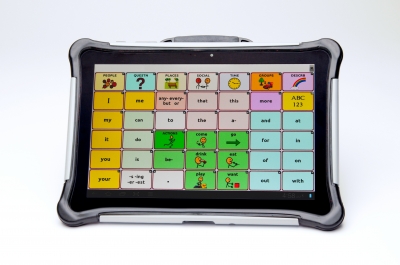 |
| Example of a "stand-alone" device. NOVA Chat 10 from Saltillo. |
There are several benefits to this kind of device. They tend to come with more support and training from the device company, and often are available in several form factors. Most are made by companies that have been in the AAC business for a long time, and the new devices are their next generation solutions. Companies will often allow 30 or 60 day trials with loaner devices as well.
These stand alone devices are very expensive, costing $3,000-$5,000 or more. However, it tends to be easier to get insurance coverage for the stand-alone devices.
Apps
There are many apps that can be purchased and loaded on iPads or Android devices. This approach seems to be where most of the action is these days. Custom hardware is complicated to make and expensive to support. By creating an app for sale in the Apple or Google store, AAC companies can reach many more customers and lose the overhead of device manufacturing.
For a user, there are several benefits to getting an app instead of a stand alone device. There are lots of apps to choose from, since the barrier to entry is much lower. Because of this competition, as well as the cheaper production cycle, the apps are less expensive than the stand alone devices, and bugs can be fixed and turned around relatively quickly. In fact, if all you need is a simple app, you may be able to find something inexpensive or even free. Many of the apps also have free "lite" versions that will allow you to see what the app is about before purchasing.
 |
| iPad loaded with LAMP Words for Life |
The downsides are significant, however. Because there are many to choose from, it is harder to know which ones are from reputable companies that will be around to support their app, make updates or fix bugs. It is also harder to know how the apps really work as the lite versions are often not fully featured. App creators don't support the hardware, of course, and may not provide customer care beyond an email address or web form. And although cheaper than a device, the more robust apps still cost between $200-300. Add the cost of an iPad and high quality case (like the iAdapter), you could be approaching $1,000, and it is harder - though not impossible - to get insurance coverage for iPads used as communication devices.
Stay tuned for Part 2: An overview of the devices and apps we saw during Moe's AAC evaluation and what we selected.
July 2, 2012
Moe Finds His Voice
Moe has a really cute voice. Soft and breathy, it is the sound of the sweet boy that he is. But for a long time, I rarely heard that voice. Moe communicated in whines and cries. He'd shriek and make repetitive sounds for no one's benefit but his own. He sometimes sang, but even that had become less frequent over the past year.
That harsher voice sounded like the Moe we had been living with: aggressive, moody, out of control. I forgot the other voice--the other boy--existed.
And then, a little over a week ago, I was eating chips and he really wanted one. Moe had been getting better with physical imitation and signing, so we had been working with him on signing "I want" then pointing to a desired item, rather than just whining and grabbing. But for some reason, I thought back to my Pivotal Response Treatment (PRT) training. I held the chip up and said "chip?" Moe pointed. He grabbed and signed every sign he knew. I held his hands down and said "chip?"
And then Moe said "p."
It was just a "p" sound, but it was clearly an attempt at vocalizing his need. They were really good lime tortilla chips and we did this over and over and over. Again and again, Moe tried to say "chip."
After that, something happened. Moe is now requesting things with his voice very consistently. He still signs sometimes, and his behaviorists always want him to give eye contact even if he speaks, but he will almost always go to his voice first. He consistently says "up," "apple" and "phone." We've also gotten "open," "all done," and "more." Sometimes we get the beginning of a word and sometimes the end, and everything else gets some variation on "ba," the sound he makes most easily.
The words are all about Moe's needs and I can't exactly say Moe is talking. These are all approximations. But he is trying. He spontaneously comes to me and taps me to get my attention, and then makes a sound. I understand when Moe wants something and isn't just unhappy. Moe understands when we are trying to get him to say something. He often can't form the word or sound, but he knows what he is supposed to do.
It is a small step but it feels like a barrier has been broken.

That harsher voice sounded like the Moe we had been living with: aggressive, moody, out of control. I forgot the other voice--the other boy--existed.
And then, a little over a week ago, I was eating chips and he really wanted one. Moe had been getting better with physical imitation and signing, so we had been working with him on signing "I want" then pointing to a desired item, rather than just whining and grabbing. But for some reason, I thought back to my Pivotal Response Treatment (PRT) training. I held the chip up and said "chip?" Moe pointed. He grabbed and signed every sign he knew. I held his hands down and said "chip?"
And then Moe said "p."
It was just a "p" sound, but it was clearly an attempt at vocalizing his need. They were really good lime tortilla chips and we did this over and over and over. Again and again, Moe tried to say "chip."
After that, something happened. Moe is now requesting things with his voice very consistently. He still signs sometimes, and his behaviorists always want him to give eye contact even if he speaks, but he will almost always go to his voice first. He consistently says "up," "apple" and "phone." We've also gotten "open," "all done," and "more." Sometimes we get the beginning of a word and sometimes the end, and everything else gets some variation on "ba," the sound he makes most easily.
The words are all about Moe's needs and I can't exactly say Moe is talking. These are all approximations. But he is trying. He spontaneously comes to me and taps me to get my attention, and then makes a sound. I understand when Moe wants something and isn't just unhappy. Moe understands when we are trying to get him to say something. He often can't form the word or sound, but he knows what he is supposed to do.
It is a small step but it feels like a barrier has been broken.


October 17, 2011
The Small Picture
We often tell ourselves to "look at the big picture." In business, for example, it makes sense to look at the larger competitive landscape rather than get caught up details of a particular product design. But sometimes, the story is in the small picture.
Moe doesn't talk, and it is sometimes hard to look past that. When we started speech therapy two years ago, we thought for sure Moe would have some language by now. And if I focus on that, it feels like he hasn't progressed at all. But as our OT always points out, Moe is changing. He doesn't chew as much as he used to. That nasty spitting habit he developed at the start of the school year seems to have all but disappeared. It is hard to see that going from biting to spitting to whatever is going to come next is progress, but what is important is that Moe is different now than he was even a few weeks ago. Change signals development, and that's what we want to see.
Moe's speech therapist at school sent an email the other day. She's noticing change in him as well:
Moe doesn't talk, and it is sometimes hard to look past that. When we started speech therapy two years ago, we thought for sure Moe would have some language by now. And if I focus on that, it feels like he hasn't progressed at all. But as our OT always points out, Moe is changing. He doesn't chew as much as he used to. That nasty spitting habit he developed at the start of the school year seems to have all but disappeared. It is hard to see that going from biting to spitting to whatever is going to come next is progress, but what is important is that Moe is different now than he was even a few weeks ago. Change signals development, and that's what we want to see.
Moe's speech therapist at school sent an email the other day. She's noticing change in him as well:
- Moe is much more observant this year! He is really watching and interested in speech activities. Last year it took much more effort to keep him engaged. This year he is focused and engaged in activities.
- I am modeling the words (CVCV reduplicated words such as "mama, dada" and animal sounds "baa-baa, moo-moo") and using cued speech to exaggerate the consonant sounds. During this activity, Moe watches intently. Sometimes he smiles, and he uses a contact point to touch each card. On a few occasions, he has mouthed the consonant.
- During snack, Moe picks up his desired food, then is asked to locate the correct matching icon from a field of 3 (receptive task). For highly desired food items, Moe is doing well choosing the correct picture regardless of placement. For less preferred food (even if he chooses it initially), he tends to choose the picture on the left. Again he understands the process of choosing the picture, placing it on the strip, handing it, and touching each picture.
- Playful sound imitation. Moe has attempted to imitate "ball, more" during the last month.
- Various speech activities (such as songs, books, and toys that go with the theme) - Moe is watching the activities, and uses gaze shifting between the materials and me. He is watching modeled words, and touches items when asked and given a modeled prompt.
- Non-verbal imitation - Moe requires initial hand-over-hand, then can sustain the motor movement for a few turns.
To an outside observer, Moe still doesn't talk. But if you look at the details, there are changes. He's starting to understand the picture exchange system a bit better. He seems to enjoy attending to the activities, and may even try to imitate, rather than just tune out. Moe's development - what we can see, anyway - may not happen in leaps and bounds, but it does seem to be happening, one step at a time.
July 1, 2011
Working Out Our PECS
On Wednesday, I dropped Jelly off at my BFF's house, and met Jeff and Moe up at Lucille Packard Children's Hospital. We were there for speech evaluation with a woman recommended by Dr. S, our developmental pediatrician. I was thankful we were at a satellite building of LPCH; I find it hard to walk through the hospital without having my heart break a little for all the sick children there. Even when I was arriving to deliver my own children, happy days both, I had to keep my eyes down.
I arrived first and filled out some paperwork. Jeff and Moe walked up and Moe, already holding Jeff's hand, reached up and grabbed mine with the other. He was apprehensive at the waiting room, despite the TV, toys and books. This hesitation is something new, and I think positive, showing a little more awareness and concern for where he is and what might happen. But Moe stayed calm, and we were shown back to a room.
The SLP we met is a specialist in augmentative communication, or communication without speech. She had already reviewed Moe's latest reports and IEP and knew his background. She worked with Moe in a few different ways, and we thought he did really well. A year ago, Moe would have spent much of the time trying to leave the room, grabbing us by the hand to open the door. This time, Moe sat at the table for the entire appointment, engaging with the SLP, making requests and taking turns when prompted.
Most of the readers of this blog should be familiar with the Picture Exchange Communication System, or PECS. If you don't know about PECS, the concept is simple: instead of speaking a word to communicate something, a picture, often a graphical icon, is used. So if Moe wanted to play, he could grab the "play" icon and hand it to me. This can be done more simply to give choices; for example, at school he might be asked to point to one of two or three icons representing which song he wants to sing at circle time. In a more advanced form, multiple icons can be used to form sentences: the icons for "I want" and "eat" can be put together, for example.
The SLP used a different form of exchange with Moe, using 3-D models instead of icons. She had beads in a clear box and balls in another box. These were used as models. She then had another set of beads and a ball in her hand. She gave Moe the ball and let him play. She then said "my turn ball," pointed to the ball in the box, then held out her hand for Moe's ball. He handed it back. She did this with the beads as well, just to get him familiar with the two toys. Then she waited for Moe to make a choice. He had to point, unprompted, to the item in the box he wanted, then he would get the real thing. He understood the concept quickly and we added in more items to choose from. He started to tune out when there were 4 or more choices.
We then switched to pictures of the items, instead of the 3D versions in the boxes. Moe did okay with this, but not quite as well. He did better when the picture was held up at an angle, rather than flat on the table. We tried a few more variations with different types of equipment as well. Moe also did some nice verbal imitation playing with a microphone toy.
 We haven't had a lot of success with PECS in the past. Although I know Moe understands the basic concept, we haven't gotten much past the pointing to a choice stage. We have had a little more success with sign language, but the motor planning required to make the signs is difficult for Moe. PECS has the benefit of being understood by anyone (the words are printed under the pictures), but can require carrying around a large PECS notebook. Signing is more portable, but not universally understood.
As part of our PRT work, we've also been phasing out signing with Moe in favor of verbal attempts and this seems to be working. Moe will almost always make a verbal attempt when prompted. This is not a verbal approximation; right now, any sound will do. But this week I am starting to require more of an approximation for a few words that have high value and are easy to say, like "up" and "open."
I was a little disappointed after the evaluation. Every time we meet with someone new, I'm so hopeful that this person will be the one to discover the key to Moe's speech. I want someone to be able to look at him and tell me, do X, Y, and Z and he'll start talking. I know it doesn't work that way, but I hope anyway. We are now able to come back to see this SLP, and it is nice to have another expert on the team.
The SLP did confirm apraxia of speech, meaning there are motor planning issues in addition to the issues of understanding social communication. This is not news, though I don't think has ever been in any kind of formal assessment before. She recommended we start with the 3D models, then move to photographs before using the graphical icons. We'll be spending the weekend getting set up for that. But primarily, she said to keep doing what we're doing. There is no easy answer here. Just time, hard work, and a lot of patience.

I arrived first and filled out some paperwork. Jeff and Moe walked up and Moe, already holding Jeff's hand, reached up and grabbed mine with the other. He was apprehensive at the waiting room, despite the TV, toys and books. This hesitation is something new, and I think positive, showing a little more awareness and concern for where he is and what might happen. But Moe stayed calm, and we were shown back to a room.
The SLP we met is a specialist in augmentative communication, or communication without speech. She had already reviewed Moe's latest reports and IEP and knew his background. She worked with Moe in a few different ways, and we thought he did really well. A year ago, Moe would have spent much of the time trying to leave the room, grabbing us by the hand to open the door. This time, Moe sat at the table for the entire appointment, engaging with the SLP, making requests and taking turns when prompted.
 |
| Sorry, wrong kind of pecs |
The SLP used a different form of exchange with Moe, using 3-D models instead of icons. She had beads in a clear box and balls in another box. These were used as models. She then had another set of beads and a ball in her hand. She gave Moe the ball and let him play. She then said "my turn ball," pointed to the ball in the box, then held out her hand for Moe's ball. He handed it back. She did this with the beads as well, just to get him familiar with the two toys. Then she waited for Moe to make a choice. He had to point, unprompted, to the item in the box he wanted, then he would get the real thing. He understood the concept quickly and we added in more items to choose from. He started to tune out when there were 4 or more choices.
We then switched to pictures of the items, instead of the 3D versions in the boxes. Moe did okay with this, but not quite as well. He did better when the picture was held up at an angle, rather than flat on the table. We tried a few more variations with different types of equipment as well. Moe also did some nice verbal imitation playing with a microphone toy.

As part of our PRT work, we've also been phasing out signing with Moe in favor of verbal attempts and this seems to be working. Moe will almost always make a verbal attempt when prompted. This is not a verbal approximation; right now, any sound will do. But this week I am starting to require more of an approximation for a few words that have high value and are easy to say, like "up" and "open."
I was a little disappointed after the evaluation. Every time we meet with someone new, I'm so hopeful that this person will be the one to discover the key to Moe's speech. I want someone to be able to look at him and tell me, do X, Y, and Z and he'll start talking. I know it doesn't work that way, but I hope anyway. We are now able to come back to see this SLP, and it is nice to have another expert on the team.
The SLP did confirm apraxia of speech, meaning there are motor planning issues in addition to the issues of understanding social communication. This is not news, though I don't think has ever been in any kind of formal assessment before. She recommended we start with the 3D models, then move to photographs before using the graphical icons. We'll be spending the weekend getting set up for that. But primarily, she said to keep doing what we're doing. There is no easy answer here. Just time, hard work, and a lot of patience.
May 20, 2011
IEP Season
Spring is in the air, and though many of you might be sneezing and wheezing with seasonal allergies, most of the parents at Moe's school are having reactions to the other thing that starts coming up around mid-April: IEP meetings.
Yesterday, we had Moe's Individual Education Plan (IEP) meeting. We discussed the year's progress against his current IEP as well as the aspects of the Competent Learner Model that is used in our special education classrooms.
It is hard to believe that one year ago, we were in our first IEP meeting, getting ready to transition out of our home-based ABA program and into preschool. We had no idea if this program was a good one. We set goals that were a bit of a shot in the dark.
Moe did well this year. His strength's are in areas of problem solving, and I think I'll take some time over the next few weeks to go through the specifics of the CLM and how he's progressed. Moe is also making progress interacting with adults. His teacher believes this is a precursor to playing with other kids.
Next year, Moe will get the same services he's getting this year: the autism preschool program with our beloved Mrs. M, as well as some group and individual speech therapy. We set out fewer IEP goals than last year, but they are more focused, especially around communication and play skills. There are also some pre-academic goals around reading and writing. The highlight of the meeting was when Mrs. M showed us some tracings Moe recently did of his name. He required assistance, but she said he was excited about writing his name and did a pretty good job, especially with the first letter!
Our biggest challenge will be getting Moe consistently using his skills, since he will often do something a few times, then be done with it. Then out of the blue, a few days or weeks later, he'll do it again.
Because the classroom uses the CLM, they are always working on moving the kids through the areas the model identifies as required for school success. So even if certain skills are not identified as IEP goals, they are still covered as part of the CLM.
I am disappointed that Moe wasn't able to meet our speech goals this year. We had hoped he'd have 100 words (10 words in 10 categories, like toys, foods, animals, etc.) but we've identified 5 words that he uses fairly consistently: yeah, more, open, frog and jumping. So next year, we've set a goal of 15 words. It is our hope that once he starts speaking, he'll acquire new words rapidly, but for now, maybe focus will help.
For many families, the IEP process can be stressful and contentious, sometimes involving advocates and lawyers. I think it can be especially hard to get services for kids with high-functioning autism and Asperger's, since they often assess well and get good grades. We could fight for more, and the one area that bothers me is the extended school year program, which only covers four of the 10 weeks of summer. We're going to be sending Moe to a private preschool for the second half of the summer, and we've thought about asking the school district to pay for this, since Moe clearly needs to be engaged during that time. But as of right now, we've chosen not to take on that fight.
How's everyone else doing with their IEPs?
Yesterday, we had Moe's Individual Education Plan (IEP) meeting. We discussed the year's progress against his current IEP as well as the aspects of the Competent Learner Model that is used in our special education classrooms.
It is hard to believe that one year ago, we were in our first IEP meeting, getting ready to transition out of our home-based ABA program and into preschool. We had no idea if this program was a good one. We set goals that were a bit of a shot in the dark.
Moe did well this year. His strength's are in areas of problem solving, and I think I'll take some time over the next few weeks to go through the specifics of the CLM and how he's progressed. Moe is also making progress interacting with adults. His teacher believes this is a precursor to playing with other kids.
Next year, Moe will get the same services he's getting this year: the autism preschool program with our beloved Mrs. M, as well as some group and individual speech therapy. We set out fewer IEP goals than last year, but they are more focused, especially around communication and play skills. There are also some pre-academic goals around reading and writing. The highlight of the meeting was when Mrs. M showed us some tracings Moe recently did of his name. He required assistance, but she said he was excited about writing his name and did a pretty good job, especially with the first letter!
Our biggest challenge will be getting Moe consistently using his skills, since he will often do something a few times, then be done with it. Then out of the blue, a few days or weeks later, he'll do it again.
Because the classroom uses the CLM, they are always working on moving the kids through the areas the model identifies as required for school success. So even if certain skills are not identified as IEP goals, they are still covered as part of the CLM.
I am disappointed that Moe wasn't able to meet our speech goals this year. We had hoped he'd have 100 words (10 words in 10 categories, like toys, foods, animals, etc.) but we've identified 5 words that he uses fairly consistently: yeah, more, open, frog and jumping. So next year, we've set a goal of 15 words. It is our hope that once he starts speaking, he'll acquire new words rapidly, but for now, maybe focus will help.
For many families, the IEP process can be stressful and contentious, sometimes involving advocates and lawyers. I think it can be especially hard to get services for kids with high-functioning autism and Asperger's, since they often assess well and get good grades. We could fight for more, and the one area that bothers me is the extended school year program, which only covers four of the 10 weeks of summer. We're going to be sending Moe to a private preschool for the second half of the summer, and we've thought about asking the school district to pay for this, since Moe clearly needs to be engaged during that time. But as of right now, we've chosen not to take on that fight.
How's everyone else doing with their IEPs?
December 22, 2010
Too Much Information

Just this week, I've learned that autism may be caused by: mitochondrial dysfunction, living too close to freeways, and living near a cement plant. In the past, I've also read that autism is caused by: heredity, other genetic mutations, vaccines, bad parenting, heavy metals in the bloodstream, premature birth, and allergies. The list goes on. (Read this great summary of the flaws in some of the recent research.)
Within autism, there are so many diagnoses and co-morbid conditions: high functioning to severe, Asperger's, apraxia, sensory processing disorder, hypotonia, hyperlexia, and echolalia to name a few.
And then there are the plethora of therapies out there, including but not limited to: ABA, Floortime, SonRise, Pivotal Response Training, Relationship Development Intervention, occupational therapy, speech and language therapy, sensory integration therapy, music therapy, recreation therapy, riding horses, surfing, gluten free casein free diets, chelation, B12 shots, other vitamin and mineral supplements, essential fatty acids, fish oil supplements, gut treatments including probiotics and antifungals, and hyperbaric oxygen therapy.
It is enough to make a person crazy.
Our approach has always been:
- Let the science guide us.
- Go to trusted professionals for guidance.
- Do no harm.
- Do what works for our family.
We recently added some music therapy, which is also a lot like ABA but using music (instruments, musically based games, singing, etc.). This is not "traditional" but because Moe is so musically inclined, we thought at the very least it could be fun for him. Our music therapist also teaches older spectrum kids to play instruments so my hope is we are building a basis for that in the future as well.
We've recently decided to add in some more OT. It's not going to be strictly sensory integration therapy but we will focus a lot on Moe's sensory-seeking needs. He has a lot of them (chewing, spinning, swinging, etc.). We've had to delay starting because of all our illnesses but I hope we can give Moe some of that extra input he needs to help keep himself more regulated and focused throughout the day.
I am not advocating this approach for everyone, but it is what we can handle. I do think it makes a lot of sense to start small and add in as you go, both in terms of keeping some sanity and for tracking progress. But every day I question whether we're doing the right things, too much or too little. Jeff seems more confident in our approach, and that's good, because I'm sure I'd be all over the map if these decisions were mine alone.
Autism may be a puzzle, but its really the maze of options for parents that is so confounding.
December 2, 2010
Day 3: Moe's Favorite Things (video edition)
It's been a busy day, so I'm going to cheat a little on our "Moe's Favorite Things" holiday special and just say that what Moe really loves to do is be really, really active. If we let him go at a park, he'll just run and run. At home, he spins, runs, climbs and jumps. He can get quite manic, actually. I used to try to calm him down when he got in these moods, afraid that over-excited Moe would quickly turn to over-tired Moe and end in a screaming meltdown. But a recent OT consultation helped us realize that Moe needs these releases of energy, and that we can use them rather than work against them. That led to us making a few changes in Moe's schedule, like giving him a bath (a very exciting activity) in the afternoons instead of right before bed.
I also try to use Moe's energy to try to get some language out of him. For those of you who don't know Moe, he is able to talk some. He has very little functional language, so that is obviously something we work on a lot. He used to talk more, mostly labeling things, and was easy to understand. But now, when he does talk, he has trouble forming the words. It is almost like he hasn't used those mouth muscles so he needs to build them up again. But lately he seems a bit more willing to try, so I use every opportunity to hear his words. Here is an example of that. Enjoy!
I also try to use Moe's energy to try to get some language out of him. For those of you who don't know Moe, he is able to talk some. He has very little functional language, so that is obviously something we work on a lot. He used to talk more, mostly labeling things, and was easy to understand. But now, when he does talk, he has trouble forming the words. It is almost like he hasn't used those mouth muscles so he needs to build them up again. But lately he seems a bit more willing to try, so I use every opportunity to hear his words. Here is an example of that. Enjoy!
October 7, 2010
A little progress goes a long way
Ahhh...quiet. There hasn't been enough of that this week. If you read my last post, or have followed my blog for a while, you know that we've been having some pretty serious sleep issues for about the past year. I won't bore you with the details of the rest of this week. Suffice it to say that we've been experimenting and have had some successes and some failures. Last night, Moe got to sleep on his own without melatonin (success). Tonight, we ate our spaghetti to Moe's screaming in the background (failure).
On top of that, Jelly has been sick with a fever, runny nose, the works. And she only wants mommy. When Jeff even tries to go near her, she screams "no!" (her new favorite word) and clings harder to me. It was cute once.... Once.
Despite all of that, Moe had an interesting day at school yesterday. When I picked him up, his teacher, the Magnificent Mrs M, came running over to me to tell me how talkative Moe was! She put a list in his daily communication book of everything he said that day: stamp, morning, four, please, open please, more, more pear, and mad.
These were pretty interesting to me for a few reasons.
Of course, I'm so proud, but I'm also trying to figure out what made that day so great and how I can recreate it. The rest of the day, Moe continued to be happy and well regulated, though less chatty than he was at school. The only thing I know is that this fabulous day came after Moe had a full night's sleep, which is something I seem to have very little control over. I don't think this is a coincidence.
It has been a tough week, but this note was just what I needed to make it through the rest of the week. A little progress goes a long way.
On top of that, Jelly has been sick with a fever, runny nose, the works. And she only wants mommy. When Jeff even tries to go near her, she screams "no!" (her new favorite word) and clings harder to me. It was cute once.... Once.
Despite all of that, Moe had an interesting day at school yesterday. When I picked him up, his teacher, the Magnificent Mrs M, came running over to me to tell me how talkative Moe was! She put a list in his daily communication book of everything he said that day: stamp, morning, four, please, open please, more, more pear, and mad.
These were pretty interesting to me for a few reasons.
- "Morning" was in response to Mrs M saying "Good morning, Moe." Socially appropriate!
- "Open please" and "More pear" are two word phrases. Haven't heard those before!
- He said "mad" when he was tired of the aide, Super K, working with him at snack. He expressed an emotion! (I haven't mentioned Super K before, but she's great and I'm sure I'll be mentioning her again.)
Of course, I'm so proud, but I'm also trying to figure out what made that day so great and how I can recreate it. The rest of the day, Moe continued to be happy and well regulated, though less chatty than he was at school. The only thing I know is that this fabulous day came after Moe had a full night's sleep, which is something I seem to have very little control over. I don't think this is a coincidence.
It has been a tough week, but this note was just what I needed to make it through the rest of the week. A little progress goes a long way.
September 28, 2010
A Little Bit of Bragging
I don't spend a lot of time bragging about my kids' accomplishments. This might because they are one and three years old and don't have a lot of accomplishments, per se. This might also be because Moe's accomplishments, though huge to us, are more like baby steps to others with kids his age. And Jelly's feats are, by now, old news to those who have already gone through them with an older child. But this is my blog and I can do what I want to, so I'm going to brag about a couple of very cool things that happened in the past few days.
As you can imagine, I tell Moe "I love you" about a thousand times a day. I want him not just to hear it but to know it in his bones. I used to be able to kind of sing "I....looove..." and he'd fill in "yoooou." But those fill-in days are long behind us. So the other day, he was sitting on my lap. You might say he was "cuddly." I'd call it "sensory seeking." But either way, we were at the table and he started to squirm like he wanted to get down. As I was putting him down, I said "I love you!" And then, Moe said "love you!" Let me repeat,

As you can imagine, I tell Moe "I love you" about a thousand times a day. I want him not just to hear it but to know it in his bones. I used to be able to kind of sing "I....looove..." and he'd fill in "yoooou." But those fill-in days are long behind us. So the other day, he was sitting on my lap. You might say he was "cuddly." I'd call it "sensory seeking." But either way, we were at the table and he started to squirm like he wanted to get down. As I was putting him down, I said "I love you!" And then, Moe said "love you!" Let me repeat,
MOE SAID "LOVE YOU!"
Then walked away like it was no big thing. Jeff and I couldn't believe it (and I was so glad he was there to hear it too). It was truly one of the highlights of my entire life. I don't know if he was just repeating back what I said (which isn't something he usually does), or if he's starting to learn the response, but I don't flippin' care. It was awesome.
Then, there's this:

This is Jelly's work. We were at our mommy & me class. On one side of the dance studio where the class is held, there were a bunch of vehicle toys, like cars, airplanes and boats. All the way on the other side of the room, there were these two bumpy logs. I don't know what they were for, other than looking and feeling interesting. Jelly played with the cars for a while. Then she explored and found these logs, and looked and felt them for a bit. Then she got up, walked across the room and picked up two boats. She carried them all the way back across the room and put them down as shown: the blue boat on the blue log and the red boat on the red log.
I have no idea why she did this or how she thought of it. This certainly wasn't imitation of any sort. I don't know what it means (and when you have a special needs kid, of course everything has to mean something). Color matching could be a totally age-appropriate developmental step right now. I have no idea. But clearly, she's a genius.
August 23, 2010
Back to school and dreaming big

Many of the kids in Moe’s old playgroup will be starting preschool this year. I’m looking forward to seeing the pictures of them in their new school clothes, backpacks on and lunch boxes in hand. For Moe, this is old hat. He’s been going to school off and on for over a year now. Although there were some tears at drop off today, as soon as he saw his old classroom, he was all smiles. His teachers greeted him with big hugs.
This is a really important year for Moe. Last year was a really important year too, and it didn’t go as well as I had hoped. It took a few months for us to find the right program. And when we did finally get him the right type of therapy, I had such high hopes for the progress he would make. I imagined that at the end of a year, he would be connecting, talking, communicating. Maybe he’d still have some social issues, difficulty with play and imitation, but he’d be getting back on track. Moe did make progress, but quite honestly he’s not where I wanted him to be. I don’t think we made any mistakes, and there are only a few things I might have done differently (knowing what I know now), but developmentally, he just wasn’t ready to do what I hoped he would be doing, especially in language development.
So here we are. Moe is three and not talking, though lately it seems as if he may be trying again. He’s back in our public school’s preschool autism program, which he attended for just a total of 6 weeks at the end of last year and during the extended school year. Today, we’re starting fresh with a great program and wonderful teacher and again I have such high hopes. I’m afraid to wish for too much so I’m not disappointed – no, heartbroken – again. Jeff reminds me that we have to hope for it all, because what else would we do? Hope for less? If there is one thing I’ve learned, it is to never set the bar too low.
At work, we would always set some stretch goals for a project. These were the tasks we hoped to achieve, but that were probably slightly out of reach. In the striving for them, however, we probably accomplished more than we would have without them. So this year, I will let my hopes and dreams for Moe stretch as far as as I can imagine.
July 27, 2010
Maybe the soup isn’t cold enough

The story is about a boy. He seems like any other boy, except he doesn’t talk. He’s two years old, then three. But he’s happy and lovable, so his parents don’t worry about it too much. By the time he was five years old, he still hadn’t said a word. Not one. Then one day at dinner, he looks up to his mom and says “The soup is cold.”
His parents are beside themselves. They can’t believe it! Their boy can talk! And so clearly! When they finally recover from the shock, they ask their son why he hasn’t said anything before. He replies “Up until now, everything was fine.”
I often question whether or not I’m making the soup cold enough for Moe. In other words, do I make things too easy for him so that he doesn’t have to communicate? About half way through his ABA program last year, we started pushing him pretty hard. The idea was to increase his frustration level so that he would need to communicate with us. This seemed to work for a while, but then he shut down. He isn’t motivated by too many toys, so we used food as a motivator. But meals became incredibly frustrating and tear- and tantrum-inducing. So we backed off, and then that seemed to work. He would tell me “more” or “all done” with signs or sometimes words. But once again, we seem to be back to more tears and less communication. I think it may be time to start requiring more from him again.
This kind of up and down and constant experimentation always makes me question if we’re doing the right things with Moe. We know that we need to keep working hard. The research shows that early intervention does make a difference. But in the back of my head I’m always wondering how much it matters – if he’s just developing on his own terms and will talk when he has something to say. When he does, I hope it’s not to complain about my cooking.
January 25, 2010
A Picture is Worth a Thousand Meltdowns

Moe's sessions start at 8:00 in the morning, so between 7 and 8, I have to get myself up and dressed, give Jelly Belly her bottle, and get Moe up, dressed and fed. Even with Jeff's help, this often seems like an impossible task. But we've managed to get it done. Until recently.
Meals have become a challenge in our house. Moe is starting to have an attitude opinion about what he eats. He knows what he wants, but isn't usually able to tell us. He has been getting very, very frustrated. Moe knows how to say "more" and many other food words, but when he's tired, and hungry, and frustrated, he has trouble finding the words. This battle often ends with him, and sometimes both of us, in tears.
The best way to deal with this type of meltdown is to try to avoid it. Our program director suggested I make sure to give him the words he needs to use, then sit back and wait. For example, I'll say "do you want more waffles?" Then I'll wait. But it doesn't usually work. Maybe those aren't the words he needed because he wanted something else. And once the frustration and tears have set in, it is very hard to get past them. Sometimes I think I hear a word, but can't understand it because of the crying.
So I'm trying a new approach. Kids without speech are sometimes taught the Picture Exchange Communication System (PECS). We don't formally do PECS or use picture schedules with Moe yet. But during his circle time, the therapists have Moe choose the song he wants to sing by using picture cards, so I decided to build on this concept.
I made some laminated cards (http://www.goosiecards.com/) with pictures of Moe's favorite foods on them. Right now, I'm introducing the concept by showing him the cards with the picture of whatever he's eating at the time. I am also starting to present a choice, by showing him two cards and asking if he wants, say, "pizza" or "chicken nuggets." (Yes, that was the choice. Don't judge me.) Moe isn't very patient, so if he chooses pizza, but doesn't get it RIGHT THEN, he might lose it. So I'm finding this works best right now with things at the ready, like yogurt and applesauce. Moe has trouble making a choice, so it also works best with only two choices.
As time goes on, we can expand the time delay and the field from which Moe chooses. My goal is to start avoiding some major meltdowns during meals. And Moe should be happier too.
October 5, 2009
How about them apples?
This has been a tough few days for Moe. He's finally getting his last two top molars and he has a little bit of a cold. He's been waking up very grumpy. I understand his frustration, but when he's grumpy, I'm grumpy. It's been challenging.
Yesterday, Moe woke up pretty much hysterical. He was frustrated and clearly trying to say something. Apple? Yes, he's saying apple! Okay, so I run to get the applesauce. Nope, not it. More frustration, more hysterical crying. Now he's saying something else. "I want?" I have thought that he's tried to say that in the past, but was never sure. At school, they have been working with him on saying whatever it is that he wants ("more," "cracker," "apple," etc.), but just the label, or sometimes even eye contact, is enough for him to get it. The more verbal kids, however, have to say "I want." Now, Moe may often seem tuned out, but he picks up a lot and often surprises me with what he knows. So he's crying hysterically, saying "I want (sniff, sniff, cry, cry) I want!" And then, he looks right at me and says "I want apple!"
Oh. My. God. Moe just: 1. Said a full sentence, and 2. Told me what he wanted. HUGE!
Now I panic. I don't have any apples, and he didn't want the applesauce, which is what he usually means by "apple." Then I remembered I had bought some packages of freeze dried apple slices that I sent with him to school last week. Moe ate two entire packages.
Yesterday, Moe woke up pretty much hysterical. He was frustrated and clearly trying to say something. Apple? Yes, he's saying apple! Okay, so I run to get the applesauce. Nope, not it. More frustration, more hysterical crying. Now he's saying something else. "I want?" I have thought that he's tried to say that in the past, but was never sure. At school, they have been working with him on saying whatever it is that he wants ("more," "cracker," "apple," etc.), but just the label, or sometimes even eye contact, is enough for him to get it. The more verbal kids, however, have to say "I want." Now, Moe may often seem tuned out, but he picks up a lot and often surprises me with what he knows. So he's crying hysterically, saying "I want (sniff, sniff, cry, cry) I want!" And then, he looks right at me and says "I want apple!"
Oh. My. God. Moe just: 1. Said a full sentence, and 2. Told me what he wanted. HUGE!
Now I panic. I don't have any apples, and he didn't want the applesauce, which is what he usually means by "apple." Then I remembered I had bought some packages of freeze dried apple slices that I sent with him to school last week. Moe ate two entire packages.
August 18, 2009
Progress report
Since my last post was so long, I'll try to make this short. In the past 2 weeks or so, Moe has showed some real progress. Although he is still inconsistent with what he does, I'm encouraged that he has been using more words and verbal communication. I'm especially excited that he has used some words or sounds completely unprompted, rather than just echoing something that one of us said.
- Signs for "more" occasionally
- Said "juice" while drinking a juice box
- Said "baby" when looking at Jelly Belly
- Pointed to Jelly's belly button when asked
- Blew me a kiss when I got him up from a nap. Blew a kiss to Grandma.
- Played with phone - held up to ear and pretended to talk
- Reading books out loud (this is too cute)
- Waved bye-bye
- Ran up to me at the park with a huge grin on his face and looking me right in the eye
- Said "bubbles" when he saw a picture of a boy with bubbles
- Saw a cow and said "moo"
- Saw a toy dog and said "dog"
- Said "pizza" when he was eating pizza (this one was in response to us saying it)
- Said "peek a boo" when I found him hiding behind the curtains (totally unprompted!)
- Today, we went to Jeff's office for lunch and as we pulled into the parking lot he said "Daddy"
Each of these are little things, but I hope they are starting to add up to some bigger progress. We're working hard to get him some individualized services ASAP. I'm hopeful that it will help speed things up even more.
August 6, 2009
Thanks for the juice box
Today was a good day. Last night was not a good night, as I spent hours reading autism blogs and reading about epilepsy and absence seizures. Okay, here's where we discover my true neurosis: I caught Moe staring into space for a few seconds and immediately went off the deep end. He hasn't even been diagnosed with ASD yet.
But today was a good day. After a morning visit to a dear friend and personal savior (who also happens to be a therapist), we went to water the plants at another friend's house. Of course, just as we arrived, I realized that it was almost 12:30 and Moe hadn't had lunch yet. Cue meltdown.
Desperate, but not wanting to snoop too much, I opened the fridge and found 3 juice boxes. Since she has 2 kids, I figured I could appropriate one for Moe. After drinking some of the juice I asked Moe if he wanted more and he said "juice!" And earlier today, he said "baby" when he saw a picture of Jelly Belly. But juice! Juice is a new word that he has never said before.
Now, I could go down the destructive path that reminds me that I should have been celebrating this achievement a year ago. I could dwell on the fact that Moe's morning playdate, who is 6 weeks younger than Moe, has the vocabulary of a third grader. I can re-read for the hundredth time the passage from the doctor's report, even though I have already memorized it, that contains the words "red flags" and "autism spectrum."
But today was a good day. I will dance the juice box dance to the sound of the ABC's coming from the fridge phonics toy and I know that Moe will join me.
Subscribe to:
Posts (Atom)
LinkWithin
